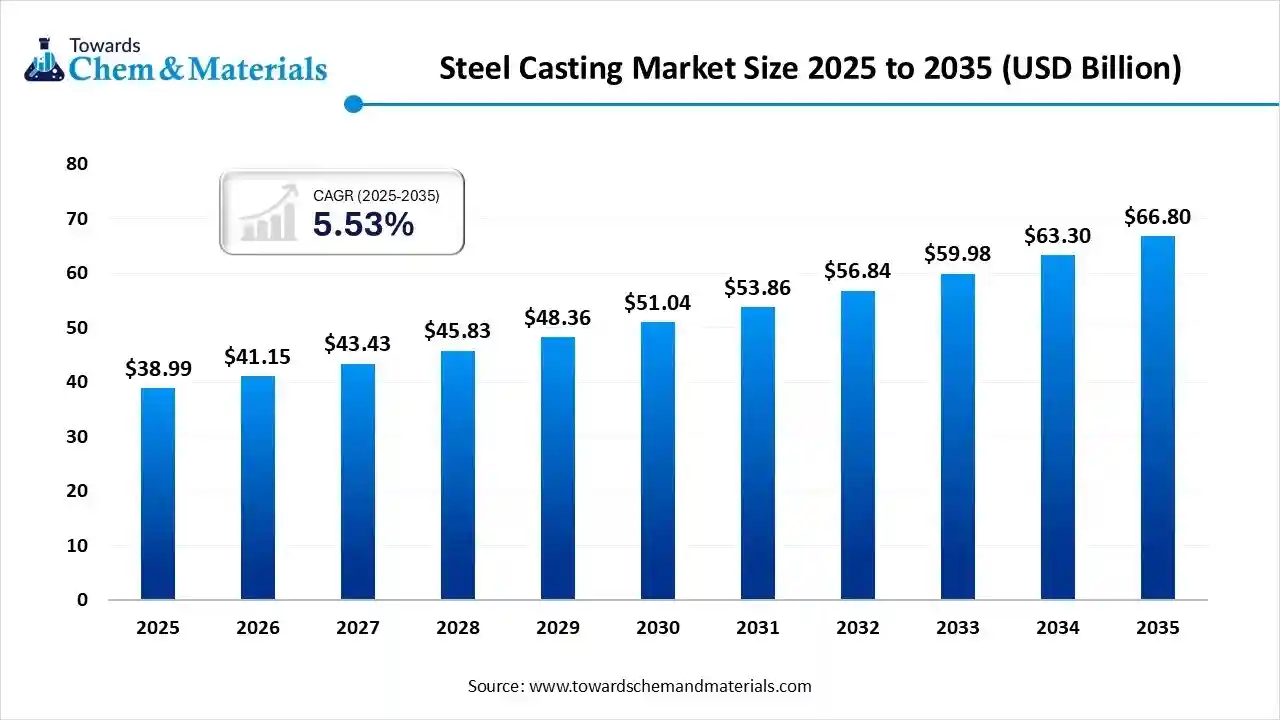
Ottawa, Dec. 12, 2025 (GLOBE NEWSWIRE) -- According to Towards Chemical and Materials Consulting, the global steel casting market size reached at USD 38.99 billion in 2025 and is predicted to increase by USD 41.15 billion in 2026 and is expected to be worth around USD 66.80 billion by 2035, exhibiting at a compound annual growth rate (CAGR) of 5.53% over the forecast period 2026 to 2035. Rising demand for high-strength, durable components in the automotive and construction industries is driving growth in the steel casting market. A study published by Towards Chemical and Materials a sister firm of Precedence Research.
Download a Sample Report Here@ https://www.towardschemandmaterials.com/download-sample/6061
What is Steel Casting?
The steel casting market is experiencing steady growth as industries continue to prioritize high-strength, durable, and dimensionally stable components. Steel castings are widely used in automotive, construction, mining, agriculture, marine, and power generation equipment due to their ability to withstand heavy loads, corrosion, and high temperatures. Growing infrastructure development, expansion of energy projects, and increased production of heavy machinery are contributing to the rising demand for cast steel parts.
Technological advancements such as improved moulding techniques, precision casting, automation, and digital simulation are enhancing production efficiency and enabling the manufacture of more complex geometries. At the same time, manufacturers are increasingly focusing on sustainability, including improved recycling practices and energy-efficient processes, which are shaping modern foundry operations.
Request Research Report Built Around Your Goals: sales@towardschemandmaterials.com
Steel Casting Market Report Highlights
- Asia Pacific dominated the global steel casting market with the largest revenue share of 56.19%. in 2025
- By type, the carbon steel segment accounted for the largest market revenue share of over 42.11% in 2025.
- By process, the sand-casting segment accounted for the largest market revenue share of over 40.15% in 2025.
- By application, the power generation segment accounted for the largest market revenue share of over 49.81% in 2025.
Advantages of Using Steel Casting Products
Robust Strength and Durability
Any component produced to meet the machinery standards must possess strength and durability. One of the prominent advantages of steel casting across various industries is its compelling strength and durability. Moreover, casting products quality is particularly crucial in industries where structural integrity is of utmost importance, such as automotive, construction, and aerospace.
Design Flexibility
Steel casting often comes with a variety of designs and flexibility. The cast steel process creates complex shapes that appear tough with other manufacturing processes. In the steel foundry, engineers ensure precision in the form and size of the cast steel while working on the steel casting process. The transformation, starting from the design process to the final product, is simple and fast and helps shorten the delivery time.
Cost-Effective Production
The cost of production plays a vital role in any industry. While steel casting offers excellent quality and precision, it has also resulted in one of the industry’s most efficient and cost-effective manufacturing methods. By optimizing the use of resources and reducing waste throughout the production process, longevity and durability contribute to the cost-effectiveness of steel casting products.
Versatility in Applications
Cast steel products are used across diverse industries for various applications. For instance, they are widely used in critical engine and structural components in the automobile and construction industry. Cast steel’s durability benefits power generation, while the mining industry relies on it for robust machinery parts. These properties have made steel castings a critical component across various industrial applications.
Customization Properties
A steel casting product has tremendous machinability and weldability. Being metallurgically versatile, casting allows the designers to choose different chemical compositions required to fulfill the project’s needs. This allows feasible machining and welding for further customization and adjustments, amplifying the overall performance of the end product.
Industry Reports Signal Strong Future for Steel & Investment Castings
Austin Alloy Cast, leveraging its capabilities and metallurgical proficiency is strategically placed to meet this growing worldwide need.
- Industry Reports Signal Strong Future for Steel & Investment Castings
- Recent analyses of the investment casting and steel casting markets reveal:
- Rapid adoption of complex, near net shape cast components
- Higher usage of alloy steels, duplex steels, nickel alloys and high strength grades
- Increased investment in machined, ready to assemble cast products
- Rising outsourcing and supplier diversification among global OEMs
These documents verify that steel castings remain crucial in scenarios where robustness, resistance, to corrosion pressure endurance and extended reliability are indispensable.
Reasons Behind Increasing Demand: Expansion, in Key Heavy Industries
1.Construction & Infrastructure
High strength steel castings are essential, for structural elements, crane components, heavy earthmoving machinery and foundation frameworks.
2. Mining & Material Handling
Durable castings designed for crushers, conveyor equipment and drilling machines remain in worldwide demand.
3. Railways & Transportation
Cast steel is extensively used in bogies, couplers, brake parts, housings and underframe assemblies.
4. Oil & Gas & Petrochemicals
Steel castings that are corrosion resistant and capable of withstanding pressure are required for valves, pumps, drilling machinery and parts of refineries.
5. Defence & Marine Engineering
Robust frameworks parts and propulsion mechanisms rely on accurately crafted steel castings.
6. Renewable Energy
Cast steel components are being increasingly chosen for wind turbines, hydroelectric installations and solar power facilities due, to their dependability and durability.
For foundries possessing the expertise and quality frameworks this expansion, across industries presents a significant opportunity.
Immediate Delivery Available | Buy This Premium Research Report@ https://www.towardschemandmaterials.com/checkout/6061
Metal Casting Market Report Scope
| Report Attribute | Details |
| Market size value in 2025 | USD 41.15 Billion |
| Revenue forecast in 2035 | USD 66.80 Billion |
| Growth Rate | CAGR of 5.53% from 2026 to 2035 |
| Base year for estimation | 2025 |
| Historical data | 2021 - 2025 |
| Forecast period | 2026 - 2035 |
| Quantitative Units | Revenue in USD million/billion, volume in kilotons, and CAGR from 2025 to 2033 |
| Report coverage | Volume forecast, revenue forecast, competitive landscape, growth factors, and trends |
| Segments covered | By Type, By Process, By Application, By Region |
| Regional scope | North America; Europe; Asia Pacific; Latin America; Middle East & Africa |
| Country scope | U.S.; Canada; Mexico; Germany; France; Italy; Spain; China; India; Japan; South Korea; Brazil |
| Key companies profiled | Eagle Alloy, ArcelorMittal, Precision Castparts Corp. (U.S.) , Doosan Corporation (South Korea), Kobe Steel, Ltd. (Japan), Nucor Corporation (U.S.), Isgec Heavy Engineering Ltd. (India), The Japan Steel Works, LTD. (Japan), Nelcast Limited (India), Ferralloy, Inc. (Ohio), POSCO (South Korea) |
For more information, visit the Towards Chemical and Materials website or email the team at sales@towardschemandmaterials.com| +1 804 441 9344
Chemical Composition: Tailoring Properties to Applications
The chemical composition of cast steel is pivotal in determining its mechanical and physical properties. Broadly, cast steel falls into two categories: carbon cast steel and alloyed cast steel.
Carbon Cast Steel
Carbon cast steel is classified based on its carbon content:
- Low Carbon Cast Steel (≤ 0.2%): Soft and ductile, but less amenable to heat treatment.
- Medium Carbon Cast Steel (0.2–0.5%): Offers a balance between strength and ductility, suitable for applications requiring moderate hardness.
- High Carbon Cast Steel (> 0.5%): Preferred for components needing maximum hardness and wear resistance, such as cutting tools or heavy machinery parts.
Alloyed Cast Steel
Alloyed cast steel is engineered for specific properties through the addition of alloying elements:
- Low-Alloy Cast Steel (≤ 8%): Exhibits higher hardenability while retaining properties similar to carbon steel.
- High-Alloy Cast Steel (> 8%): Includes specialized steels like stainless steel, known for its corrosion resistance, and Hadfield’s manganese steel, valued for its strength and abrasion resistance.
Stainless steel, for instance, owes its corrosion resistance to chromium, which forms a protective oxide layer. Similarly, the manganese in Hadfield’s steel strengthens the material under intense working conditions.
| ASTM | Chemical Requirements | Tensile Requirements | |||||||
| STEEL GRADE | Carbon | Manganese | Silicon | Sulfur | Phosphorus | Tensile Strength | Yield Point | Elongation in 2 in. | Reduction of Area |
| Max % / Range | Min. ksi [Mpa] / Range | Min. % | |||||||
| ASTM A27 / A27M | |||||||||
| ASTM A27, Grade N-1 | 0.25 | 0.75 | 0.80 | 0.06 | 0.05 | N/A | N/A | N/A | N/A |
| ASTM A27, Grade N-2 | 0.35 | 0.60 | 0.80 | 0.06 | 0.05 | N/A | N/A | N/A | N/A |
| ASTM A27, Grade U60-30 | 0.25 | 0.75 | 0.80 | 0.06 | 0.05 | 60 [415] | 30 [205] | 22 | 30 |
| ASTM A27, Grade 60-30 | 0.30 | 0.60 | 0.80 | 0.06 | 0.05 | 60 [415] | 30 [205] | 24 | 35 |
| ASTM A27, Grade 65-35 | 0.30 | 0.70 | 0.80 | 0.06 | 0.05 | 65 [450] | 35 [240] | 24 | 35 |
| ASTM A27, Grade 70-36 | 0.35 | 0.70 | 0.80 | 0.06 | 0.05 | 70 [485] | 36 [250] | 22 | 30 |
| ASTM A27, Grade 70-40 | 0.25 | 1.20 | 0.80 | 0.06 | 0.05 | 70 [485] | 40 [275] | 22 | 30 |
| ASTM A148 / A148M | |||||||||
| ASTM A148, Grade 80-40 | N/A | N/A | N/A | 0.06 | 0.05 | 80 [550] | 40 [275] | 18 | 30 |
| ASTM A148, Grade 80-50 | N/A | N/A | N/A | 0.06 | 0.05 | 80 [550] | 50 [345] | 22 | 35 |
| ASTM A148, Grade 90-60 | N/A | N/A | N/A | 0.06 | 0.05 | 90 [620] | 60 [415] | 20 | 40 |
| ASTM A216 / A216M | |||||||||
| ASTM A216, Grade WCA | 0.25 | 0.70 | 0.60 | 0.045 | 0.04 | 60-85 [415-585] | 30 [205] | 24 | 35 |
| ASTM A216, Grade WCB | 0.30 | 1.00 | 0.60 | 0.045 | 0.04 | 70-95 [485-655] | 36 [250] | 22 | 35 |
| ASTM A216, Grade WCC | 0.25 | 1.20 | 0.60 | 0.045 | 0.04 | 70-95 [485-655] | 40 [275] | 22 | 35 |
Private Industry Investments for Steel Casting:
- Berkshire Hathaway: This major investment company is a significant player in the investment casting market, notably through its subsidiary Precision Castparts Corp., which primarily serves the aerospace and power generation industries.
- Winsert: This advanced manufacturer acquired Alloy Cast Products Inc. in October 2022 to expand its product offerings and tap into new market segments within the metal parts manufacturing sector.
- Meson Valves India: The company acquired a majority stake in Milindpra Castings Private Limited in July 2024, a newly established entity in the metal casting sector, to strengthen its market position and expand its capabilities.
- Georg Fischer Ltd. (GF Casting Solutions): GF Casting Solutions is establishing a global network of mega-casting machines to meet the rising demand for large structural cast aluminum parts in the automotive industry.
- Peekay Steel Castings: This company is investing in advanced technologies and automation, such as 3D sand printing, to enhance production efficiency and address long-term sustainability challenges related to labour costs.
What Are the Major Trends in the Steel Casting Market?
- The increased adoption of recycled steel and eco-friendly manufacturing processes reflects a growing emphasis on sustainability.
- Growing demand from infrastructure, construction, and heavy industry projects is driving more use of steel castings in metal casting applications.
- Rising use of steel cast components in defence military applications, boosting demand due to their durability and reliability.
How Does AI Influence the Growth of the Steel Casting Industry in 2025?
AI is accelerating the growth of the steel casting industry in 2025 by enabling smarter, more efficient, and more sustainable production. Through real-time monitoring, predicting maintenance, and automated quality injection, AI reduces defects and improves overall process reliability. Advanced tools such as digital twins and simulation optimize mould design and casting parameters, helping manufacturers cut waste and enhance productivity. This adoption of AI-driven systems strengthens operational efficiency, improves product consistency, and supports the industry’s shift toward modern, technology-enabled foundries.
Market Opportunity
Can Smart Factory Adoption Open New Possibilities?
Foundries using AI, sensors, and automation can improve consistency, reduce downtime, and enhance casting accuracy. The shift toward smart operations creates an opportunity for steel casters to deliver higher-quality parts with better efficiency. Companies adopting digital tools gain stronger reliability and better efficiency. Companies adopting digital tools gain stronger reliability and better control over production, helping them meet rising industry expectations.
Can Sustainability Practices Boost Industry Demand?
Steel casters that adopt cleaner processes, energy-efficient systems, and better recycling can stand out as industries seek environmentally responsible suppliers. Sustainable operations reduce waste and improve cost effectiveness while supporting local climate goals. This creates a growing opportunity for foundries that prioritise greener manufacturing.
Immediate Delivery Available | Buy This Premium Research Report@ https://www.towardschemandmaterials.com/checkout/6061
Steel Casting Market Segmentation Insights
Type Insights:
Why Carbon Steel Segment Dominated the Steel Casting Market?
The carbon steel segment dominated the market in 2024, capturing the largest share of usage among steel types. This dominance is rooted in carbon steel’s strength, wear resistance and versatility across a wide range of applications from heavy machinery and construction equipment to general industrial components, making it the go-to choose for many manufacturers seeking reliability and cost effectiveness.
The low-alloy steel segment is expected to grow at the fastest rate during the forecast period. The rising demand for lighter, yet stronger and more durable components, especially in sectors like automotive, aerospace, and heavy machinery, is driving interest in low-alloy steel. Its enhanced mechanical properties compared to basic carbon steel make it attractive for modern engineering needs, which positions it well for rapid growth in the coming years.
Process Insights:
Which Process Segment Held the Dominating Share of the Steel Casting Market In 2024?
The sand-casting segment held the largest market share in 2024. Sand casting remains widely used because it is cost-effective and well-suited for producing large, heavy, or simple geometry parts such as engine blocks, housing, and large machinery castings, making it ideal for heavy engineering and construction sector demand.
The die-casting segment is projected to grow at the fastest rate over the coming years. As demand increases for high precision, complex geometry components, die casting, with its ability to produce finer detail, surface finish, and tighter dimensional tolerances, becomes increasingly attractive.
Application Insights:
How Power Generation Segment hold the Largest Share of the Steel Casting Market in 2024?
The power generation segment dominated the market in 2024 with the largest share. The increasing global demand for energy, including both conventional and renewable power plants, has driven demand for durable, heavy-duty cast steel components such as turbine housings, generator casings, and structural parts, making power generation a major consumer of steel castings.
The construction machinery segment is predicted to grow at the fastest pace during the forecast period, especially in developing regions, where demand for robust, wear-resistant cast components for heavy equipment and construction machinery increases, boosting growth for this segment.
➤ Contact Us: sales@towardschemandmaterials.com | ☎ +1 804 441 9344
Regional Insights
What Makes Asia Pacific the Heart of the Steel Casting Market?
Asia Pacific dominated the market in 2025, thanks to its large industrial and manufacturing base, widespread infrastructure and construction activity, and growing demand from automotive, power generation, and heavy machinery sectors. These favourable structural conditions, including plentiful raw materials, cost-effective labour, and supportive industrial policies, sustain high production volumes and steady demand for cast steel components across the region.
China Steel Casting Market Trends
China stands out due to its vast foundry capacity, well-integrated supply chains, and high domestic demand for cast components across automotive, infrastructure, and heavy industry segments. Its role as a global manufacturing hub and continued investments in industrial expansion and modernization further reinforce its leading position in the regional market.
Why Is North America Becoming a Growing Region for Steel Casting?
North America is emerging as the fastest-growing regional market for steel casting, driven by increasing demand for lightweight, high-performance cast components, especially from automotive, aerospace, energy, and infrastructure sectors. The rise in electric vehicle production and a renewed focus on infrastructure modernization are fuelling demand for durable cast parts.
U.S. Steel Casting Market Trends
Within North America, the U.S. plays a leading role due to strong industrial demand, supportive policy measures for domestic manufacturing and infrastructure, and a robust presence of casting capacity foundries. The push for supply chain resilience, combined with growing needs in automotive, energy and defence sector, reinforces demand for quality steel castings. The U.S.’s advanced capabilities in precision casting and adoption of modern casting technologies strengthen its position within the regional market.
Top Companies in the Steel Casting Market & Their Offerings:
- Eagle Alloy manufactures shell-molded and airset steel and stainless steel castings primarily for the US market.
- Precision Castparts Corp. (U.S.) is a global leader specializing in investment castings for aerospace and power generation.
- ArcelorMittal focuses on high-volume continuous and ingot casting to supply semi-finished steel products globally.
- Doosan Corporation (South Korea) produces massive, heavy-unit steel castings (up to 350 tons) for power plants and shipbuilding.
- Kobe Steel, Ltd. (Japan) integrates steel production with machinery manufacturing, actively supplying various industrial steel castings.
- Nucor Corporation (U.S.) is a major US steel producer involved in diversified steel manufacturing and general market activities.
- Isgec Heavy Engineering Ltd. (India) provides comprehensive engineering solutions including various steel castings for heavy industries like power plants and sugar mills.
- The Japan Steel Works, LTD. (Japan) specializes in producing large-scale, critical cast and forged components for power generation and defense sectors.
- Nelcast Limited (India) is a prominent producer of iron and steel castings primarily serving the automotive and general engineering sectors.
- Ferralloy, Inc. (Ohio) supplies specialty alloy castings and forgings with a focus on custom solutions and hard-to-find grades.
- POSCO (South Korea) is a major global steel producer providing raw steel materials and products used in downstream casting and heavy industrial applications.
More Insights in Towards Chemical and Materials:
- Metal Casting Market : The global metal casting market size was reached at USD 161 billion in 2025 and is estimated to surpass around USD 262.91 billion by 2034, growing at a compound annual growth rate (CAGR) of 5.60% during the forecast period 2025 to 2034.
- Stainless Steel Market : The global stainless steel market stood at approximately 14.19 million tons in 2025 and is anticipated to be likely to reach approximately 21.51 million tons in 2034. growing at a CAGR of 4.73% from 2025 to 2034.
- Steel Rebar Market : The global steel rebar market size was estimated at USD 257.87 billion in 2025 and is predicted to increase from USD 272.70 billion in 2026 to approximately USD 426.51 billion by 2034, expanding at a CAGR of 5.75% from 2025 to 2034.
- Stainless Steel-Filled Polymer Filaments Market : The global stainless steel-filled polymer filaments market size is calculated at USD 85.19 million in 2025 and is predicted to increase from USD 90.61 million in 2026 and is projected to reach around USD 157.82 million, The market is expanding at a CAGR of 6.36% between 2026 and 2035.
- Steel Market : The global steel market size is calculated at USD 1.69 trillion in 2025 and is predicted to increase from USD 1.77 trillion in 2026 and is projected to reach around USD 2.66 trillion by 2035, The market is expanding at a CAGR of 4.65% between 2026 and 2035.
- Iron and Steel Market : The global iron and steel market size is calculated at USD 1.83 trillion in 2025 and is predicted to increase from USD 1.92 trillion in 2026 and is projected to reach around USD 2.95 trillion by 2035, The market is expanding at a CAGR of 4.85% between 2026 and 2035.
- Steel Rebar Market : The global steel rebar market stands at 368.91 million tons in 2025 and is forecast to reach 530.10 million tons by 2034, growing at a compound annual growth rate (CAGR) of 4.11% over the forecast period from 2025 to 2034.
- Structural Steel Market : The global structural steel market size was approximately USD 119.12 billion in 2025 and is projected to reach around USD 188.63 billion by 2034, with an estimated compound annual growth rate (CAGR) of about 5.24% between 2025 and 2034.
- Stainless Steel Market : The global stainless steel market size was valued at USD 227.95 billion in 2025 and is expected to hit around USD 357.28 billion by 2034, growing at a compound annual growth rate (CAGR) of 5.12% over the forecast period from 2025 to 2034.
- Flat Steel Market : The global flat steel market size is calculated at USD 724.33 billion in 2025 and is expected to reach USD 1,157.84 billion by 2034, growing at a CAGR of 5.35% from 2025 to 2034.
- Green Steel Market ; The global green steel-market size was valued at USD 718.55 billion in 2024, grew to USD 763.10 billion in 2025, and is expected to hit around USD 1,311.30 billion by 2034, growing at a compound annual growth rate (CAGR) of 6.20% over the forecast period from 2025 to 2034.
- Carbon Steel Market : The global carbon steel market size is calculated at USD 1,072.38 billion in 2025 and is predicted to increase from USD 1,129.53 billion in 2026 and is projected to reach around USD 1,802.47 billion by 2035, The market is expanding at a CAGR of 5.33% between 2026 and 2035.
- Hot Rolled Coil (HRC) Steel Market : The global hot rolled coil (HRC) steel market size was accounted for USD 355.42 billion in 2024 and is expected to be worth around USD 621.65 billion by 2034, growing at a compound annual growth rate (CAGR) of 5.75% during the forecast period 2025 to 2034.
- Aluminum Casting Market : The global aluminum casting market size is calculated at USD 106.13 billion in 2025 and is predicted to increase from USD 111.38 billion in 2026 and is projected to reach around USD 172.05 billion by 2035, The market is expanding at a CAGR of 4.95% between 2025 and 2035.
- Asia Pacific Metal Casting Market : The Asia Pacific metal casting market size was reached at USD 90.17 billion in 2025 and is expected to be worth around USD 142.91 billion by 2034, growing at a compound annual growth rate (CAGR) of 5.25%over the forecast period 2025 to 2034.
- U.S. Steel Rebar Market : The U.S. steel rebar market size was estimated at USD 7.31 billion in 2025 and is predicted to increase from USD 7.70 billion in 2026 to approximately USD 11.59 billion by 2034, expanding at a CAGR of 5.25% from 2025 to 2034.
- Europe Steel Rebar Market : The Europe steel rebar market size was valued at USD 145.11 billion in 2024 and is expected to hit around USD 224.28 billion by 2034, growing at a compound annual growth rate (CAGR) of 4.45% over the forecast period from 2025 to 2034.
- Asia Pacific Steel Rebar Market : The Asia Pacific steel rebar market size was reached at USD 142.16 billion in 2024 and is expected to be worth around USD 248.88 billion by 2034, growing at a compound annual growth rate (CAGR) of 5.76% over the forecast period 2025 to 2034.
Steel Casting Market Top Key Companies:
- Eagle Alloy
- Precision Castparts Corp. (U.S.)
- ArcelorMittal
- Doosan Corporation (South Korea)
- Kobe Steel, Ltd. (Japan)
- Nucor Corporation (U.S.)
- Isgec Heavy Engineering Ltd. (India)
- The Japan Steel Works, LTD. (Japan)
- Nelcast Limited (India)
- Ferralloy, Inc. (Ohio)
- POSCO (South Korea)
What is Going on Around the Global Steel Casting Industry?
- In December 2025, a major collaboration between Forte Secure and a subsidiary of China Baowu Steel Group (TISCO) was announced to trial a hydrogen-based plasma-enhanced metallurgical process in Australia. The project aims to eliminate traditional high-emission steps such as sintering, pelletizing and cooking, potentially reducing the carbon footprint of steel casting and making cast steel more sustainable.
Steel Casting Market Report Segmentation
This report forecasts revenue growth at global, regional, and country levels and provides an analysis of the latest industry trends in each of the sub-segments from 2019 to 2035. For this study, Towards Chemical and Materials has segmented the global Steel Casting Market
By Type
- Carbon Steel
- Low-Alloy Steel
- High-Alloy Steel
- Others
By Process
- Sand Casting
- Investment Casting
- Die Casting
- Others
By Application
- Power Generation
- Rail and Transit
- Mining
- Construction Machinery
- Oil and Gas
- Others
By Regional
- North America
- Europe
- Asia Pacific
- Latin America
- Middle East & Africa
Immediate Delivery Available | Buy This Premium Research Report@ https://www.towardschemandmaterials.com/checkout/6061
About Us
Towards Chemical and Materials is a leading global consulting firm specializing in providing comprehensive and strategic research solutions across the chemical and materials industries. With a highly skilled and experienced consultant team, we offer a wide range of services designed to empower businesses with valuable insights and actionable recommendations.
Our Trusted Data Partners
Towards chem and Material | Precedence Research | Statifacts | Towards Packaging | Towards Healthcare | Towards Food and Beverages | Towards Automotive | Towards Consumer Goods | Nova One Advisor | Nutraceuticals Func Foods | Onco Quant | Sustainability Quant | Specialty Chemicals Analytics | TCM Blog
For Latest Update Follow Us: https://www.linkedin.com/company/towards-chem-and-materials/
USA: +1 804 441 9344
APAC: +61 485 981 310 or +91 87933 22019
Europe: +44 7383 092 044
Email: sales@towardschemandmaterials.com
Web: https://www.towardschemandmaterials.com/