New York,USA, May 29, 2026 (GLOBE NEWSWIRE) --
Editorial note: This article is an independent informational evaluation of publicly available claims and product information. It is not medical advice, and it does not constitute an endorsement. Statements regarding dietary supplements have not been evaluated by the U.S. Food and Drug Administration. This product is not intended to diagnose, treat, cure, or prevent any disease. Readers should verify all current product details on the official website and consult a qualified healthcare professional before starting any supplement.
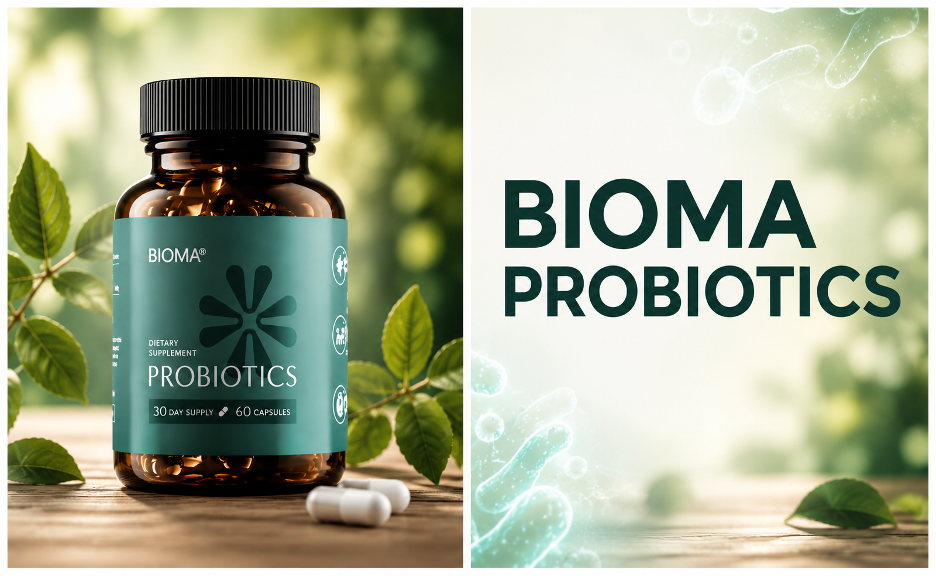
Search interest in Bioma probiotics has grown sharply as more consumers connect gut health to digestion, energy, and weight management. This evaluation examines what the Bioma probiotic actually contains, how its claims hold up against general gut-health research, what its label discloses (and what it does not), and how to interpret the Bioma probiotic for weight loss positioning that dominates its advertising.
Here is what the evaluation found in brief. Bioma is a three-part “synbiotic” formulation combining a prebiotic (xylooligosaccharides), a postbiotic (tributyrin), and a probiotic blend of three Bifidobacterium strains. Its formula is more complete than most single-strain drugstore probiotics. However, the probiotic portion is disclosed as a proprietary blend by milligram weight rather than by individual CFU count — a transparency limitation buyers should note. The weight-loss claims are best understood as indirect and supportive rather than as evidence of a standalone fat-loss product. The remainder of this article documents each of these points in detail. See Why Consumers Are Exploring Bioma Probiotics
Why Bioma Is Being Searched as a Seed Probiotics Alternative
A meaningful share of the people now searching for Bioma probiotics arrive at it while comparing options in the premium synbiotic category — the same category that brands such as Seed helped bring into the mainstream conversation. The interest in a Seed probiotics alternative is not surprising. As the modern synbiotic standard has spread, more consumers want a formula that goes beyond a single bacterial strain in a basic capsule and instead combines probiotics, prebiotic fuel, and postbiotic reinforcement, delivered in a capsule engineered to actually reach the gut. Bioma is built on that same three-pillar logic, which is why it routinely appears on shortlists of synbiotic options people consider alongside category leaders. This article does not compare the two products head-to-head; instead, it documents independently what the Bioma probiotic itself contains, how its claims hold up, and what consumers researching a synbiotic alternative should verify before buying — so that, whatever they ultimately choose, the decision is informed rather than impulse-driven. Explore Modern Gut Health Support
Why Bioma Probiotics Is Being Evaluated in 2026
A decade ago, “the microbiome” was a term confined to research labs. In 2026 it is a mainstream wellness conversation, and that shift is exactly why a product like Bioma deserves a careful evaluation rather than uncritical promotion. Researchers have increasingly connected the trillions of microorganisms in the digestive tract to immunity, mood, inflammation, and metabolism — and supplement brands have moved quickly to capitalize on that interest.
When researchers compare the gut bacteria of lean individuals to those who struggle with weight, they frequently observe differences in the diversity and composition of bacterial species. This does not mean bacteria alone determine body weight — calories, sleep, stress, hormones, genetics, and activity all matter enormously. But it establishes the gut as a legitimate area of scientific interest, and it is the premise on which Bioma probiotics is marketed: supporting a healthier internal environment so the body's natural processes can function more efficiently.
This evaluation approaches that premise neutrally. The modern Western lifestyle — high sugar intake, ultra-processed foods, frequent antibiotic use, chronic stress, poor sleep, and low fiber — can disrupt gut balance and produce a cluster of symptoms such as bloating, irregularity, gas, fatigue, and cravings. The question this article documents is whether Bioma's formulation is a credible response to that problem, and what consumers should verify before buying.
Discover the Gut Health Formula Behind Bioma
What Is Bioma? An Overview of the Product and Its Claims
Bioma is a daily gut-health supplement delivered in vegetarian capsules. Its distinguishing feature is a three-pillar approach that the brand describes as combining prebiotics, probiotics, and postbiotics in a single formula — a structure sometimes called a synbiotic or postbiotic-enhanced supplement.
The three pillars, explained simply:
- Probiotics — the live beneficial bacteria intended to populate the gut.
- Prebiotics — the fiber that feeds those bacteria so they can establish and multiply.
- Postbiotics — the beneficial compounds produced by bacterial fermentation, which deliver much of the downstream protective benefit.
Most inexpensive probiotics contain only the first pillar, often in strains and amounts that may not survive stomach acid. Bioma's central claim is that including all three pillars creates synergy: the prebiotic feeds the probiotic, the probiotic colonizes and ferments, and the postbiotic reinforces the gut lining. The brand also states the product is stimulant-free, gluten-free, and vegan-friendly, and that it uses delayed-release capsule technology so the actives reach the gut intact. These are the claims this evaluation examines.
The Bioma Label, Decoded: Dosage and Disclosure
Evaluating a supplement begins with its label. Here is what Bioma discloses per serving.
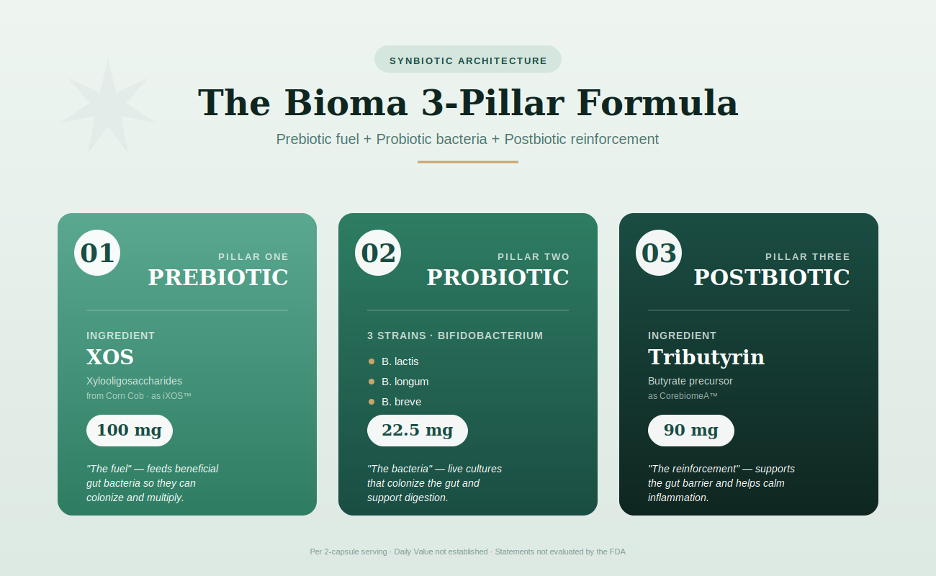
Serving Size: 2 Vegetarian Capsules | Servings Per Container: 30 (one-month supply)
The formula is sold as a Proprietary Blend with three named components:
| Ingredient | Amount Per Serving | % Daily Value |
| Xylooligosaccharides (as iXOS™, from Corn Cob) | 100 mg | † |
| Tributyrin (as CorebiomeA™) | 90 mg | † |
| Proprietary Probiotic Blend (B. lactis, B. longum, B. breve) | 22.5 mg | † |
† Daily Value (DV) not established.
What the disclosure does well
The prebiotic and postbiotic dosages are clearly stated: 100 mg of XOS and 90 mg of tributyrin per serving. That level of specificity is a positive transparency signal.
Where the disclosure falls short
The probiotic portion is labeled as a proprietary blend totaling 22.5 mg, but it does not break down the individual CFU (colony-forming unit) count for each strain. CFU is the standard measure of how many live, active bacteria a probiotic delivers, and many transparent brands list it prominently. Bioma's milligram-based proprietary blend makes direct potency comparison against a product advertising, for example, “50 billion CFU” difficult. This is common in the supplement industry, but a discerning buyer should be aware of it and may wish to contact the company for strain-level CFU data before purchasing.
In fairness, the brand's argument is that delivery and synergy matter more than raw CFU count — that a smaller dose of bacteria which actually survives to the gut, supported by prebiotic fuel and postbiotic reinforcement, can outperform a large CFU number that mostly dies in stomach acid. That is a reasonable position, but it remains a claim rather than a disclosed, independently verified figure.
Discover the Bioma Gut Health Difference
Ingredient Evaluation: What the Research Says
This section evaluates each of the three pillars against general gut-health literature.
Xylooligosaccharides (XOS): The Prebiotic
XOS is a prebiotic fiber, sourced in Bioma from corn cob and standardized as iXOS™. Its role is to selectively feed beneficial bacteria — particularly Bifidobacterium and Lactobacillus — without feeding harmful species. This selectivity is what makes XOS notable: unlike some prebiotic fibers that feed everything and can worsen gas, XOS is considered targeted and effective at relatively low doses. A double-blind, placebo-controlled clinical trial published in Food & Function found that even modest daily doses of XOS (1.4–2.8 g) significantly increased Bifidobacterium counts in healthy adults over an 8-week intervention [1]. Broader research has explored XOS for improving bowel regularity, supporting gut flora balance, and reducing constipation symptoms. Including it in the same capsule as the probiotic strains is intended to give those bacteria an immediate food source.
Tributyrin (CorebiomeA™): The Postbiotic
Tributyrin is the most distinctive ingredient in the formula and the one that most separates Bioma from competitors. It is a precursor to butyrate, a short-chain fatty acid that serves as the primary fuel for colon-lining cells, helps maintain the gut barrier, and has well-documented anti-inflammatory properties. Butyrate itself is unstable and difficult to deliver orally; tributyrin is a more stable, time-released form that can carry butyrate further into the digestive tract. Because a compromised gut barrier is linked to chronic low-grade inflammation — and inflammation is associated with metabolic dysfunction — supporting the gut lining is a plausible mechanism by which the ingredient could contribute to metabolic and digestive health. Preclinical research in obese animal models has shown that tributyrin can reduce body weight gain, improve insulin responsiveness, and lower inflammatory markers such as IL-1β and TNF-α [2]. The presence of a true postbiotic is the strongest point in Bioma's favor relative to ordinary probiotics.
The Bifidobacterium Probiotic Blend
The probiotic component features three well-studied strains. Bifidobacterium lactis is among the most researched strains for digestive regularity and tolerability. Bifidobacterium longum is associated with gut-barrier support and the gut-brain axis. Bifidobacterium breve is studied for carbohydrate breakdown. Bifidobacterium is a dominant beneficial genus in a healthy gut whose abundance tends to decline with age, poor diet, and antibiotic use, so supplementation aims to replenish what modern life depletes. The brand states these strains help break down complex carbohydrates and fiber, reduce discomfort such as bloating and constipation, and may reduce the risk and severity of diarrhea. These are consistent with general probiotic literature, though strain-specific outcomes always depend on dose, which circles back to the CFU-disclosure limitation noted above.
Verdict on the formula
Individually, each ingredient has a reasonable basis in gut-health research. The genuine differentiator is the synergistic, three-pillar design delivered in an acid-resistant capsule — a more thoughtful construction than the single-strain, no-prebiotic products that dominate pharmacy shelves.
Several peer-reviewed studies published through PubMed-indexed journals have examined the role of prebiotics, postbiotics, and Bifidobacterium strains in digestive and metabolic health
The Gut-Weight Connection: How Bioma Claims to Work
This is the area most prone to marketing overstatement, so it warrants precise language. The brand frames “bad bacteria overgrowth” as a driver of easy weight gain, increased cravings, excess fat storage, brain fog, and low energy — and positions a rebalanced gut as supporting steadier weight management, better appetite control, improved fat metabolism, and more energy.
The plausible mechanisms behind this framing are:
- Appetite and craving regulation — gut bacteria influence hormones and signaling molecules tied to hunger and satiety.
- Improved digestion and reduced bloating — feeling lighter and more comfortable supports adherence to healthy habits.
- Reduced inflammation — chronic gut inflammation is linked to insulin resistance; tributyrin's anti-inflammatory action targets this.
- Short-chain fatty acid production — compounds like butyrate play a role in energy metabolism and fat storage.
The critical caveat, stated plainly: these are supportive, indirect mechanisms, not evidence of direct fat-burning. The brand itself acknowledges that exercise and a healthy diet are necessary to achieve and maintain weight loss. The honest reading is that the supplement may remove a hidden obstacle — a dysfunctional gut — so that diet and lifestyle efforts work better, not that it replaces them.
Learn About Bioma’s Microbiome Support Formula
Bioma Probiotic for Weight Loss: Claims vs. Reality
Because “Bioma probiotic for weight loss” is among the most-searched phrases related to this product, it deserves a direct evaluation.
Can a probiotic cause weight loss on its own? No supplement should claim that, and the evidence does not support probiotics as standalone weight-loss agents. What research does suggest is that certain strains, particularly within the Bifidobacterium and Lactobacillus families, may modestly support weight-management efforts in the context of a healthy diet — by influencing appetite, fat-storage signaling, and inflammation. A 2024 randomized controlled trial of Bifidobacterium breve in 75 overweight or obese adults reported significant reductions in body weight and BMI over 12 weeks compared to placebo, alongside improvements in fasting blood glucose [3]. A larger 6-month randomized controlled trial of a Bifidobacterium-plus-fiber synbiotic in 225 overweight adults found meaningful effects on body fat mass and gut barrier markers [4]. The signal across this literature is consistent: modest, supportive effects — not standalone weight loss.
A useful mental model: picture weight management as a car. Diet is the fuel, exercise is the accelerator, and sleep and stress management are the steering. A struggling gut is like driving with the parking brake half-engaged — everything is harder. In the best case, Bioma releases that brake. It does not drive the car. The consumers most likely to benefit are those whose weight struggles are genuinely tied to gut dysfunction — chronic bloating, irregularity, intense cravings. For someone whose challenge is purely caloric or behavioral, a probiotic alone will do little.
Bottom line on this claim: buyers who expect support rather than a miracle are far more likely to be satisfied, and that expectation gap explains most negative reviews.
Who the Product Appears Suited For
Based on its formulation, Bioma appears most relevant for:
- People with chronic bloating, gas, or irregular digestion unresolved by diet changes alone.
- Those rebuilding gut flora after a course of antibiotics.
- People whose weight has stalled despite reasonable diet and exercise and who suspect gut health is a factor.
- Buyers wanting a more complete probiotic (prebiotic + probiotic + postbiotic) rather than a single-strain product.
- Vegans and vegetarians, and those avoiding stimulants.
It appears less suited for:
- Anyone expecting a fast, dramatic weight-loss pill.
- People seeking cosmetic weight loss with no lifestyle change.
- Those with serious medical conditions who have not consulted a doctor, and pregnant or breastfeeding individuals without medical clearance.
Explore Modern Gut Health Support
Realistic Timeline: What to Expect and When
Unrealistic timing expectations are a leading reason people abandon probiotics. The microbiome rebalances gradually — it is not a switch.
Weeks 1–2: Some users report early digestive shifts (less bloating, more regularity). Others notice nothing yet, which is normal. A minority experience temporary, mild adjustment effects.
Weeks 3–4: Appetite and craving changes may begin to surface for responders, with subtle energy improvements.
Weeks 6–8: The window in which beneficial bacteria more fully colonize the gut. The brand specifically cites 6–8 weeks for the bacteria to establish.
3 months and beyond: The recommended minimum for a fair evaluation, ideally alongside a fiber-rich diet. Quitting after one week does not give the product a fair test.
How to Use It for Best Results
- Take it consistently, daily, at the same time — skipping days undermines colonization.
- Pair it with dietary fiber (vegetables, fruits, legumes, whole grains) to feed the bacteria.
- Reduce sugar and ultra-processed foods, which feed harmful bacteria.
- Stay hydrated to support digestion and regularity.
- Allow 8–12 weeks before judging results.
- Separate it from antibiotics by a few hours, and consult a healthcare provider on timing.
Strengths and Limitations: An Honest Ledger
Strengths
- Three-pillar synbiotic formula — more complete than typical probiotics.
- Tributyrin postbiotic — a science-forward ingredient most competitors omit.
- Delayed-release capsules designed to survive stomach acid.
- Vegan, gluten-free, stimulant-free and broadly tolerable.
- Transparent prebiotic and postbiotic dosing, and well-researched strains.
- Money-back guarantee offered by the brand (verify current terms).
Limitations
Probiotic CFU count not individually disclosed — the proprietary blend is listed only by milligram weight.
- Premium price relative to basic drugstore probiotics.
- Requires patience (6–8+ weeks); not for instant results.
- Weight-loss benefits are indirect and depend on diet and lifestyle.
- Sold primarily online, mostly direct from the brand.
- The brand's own “results” statistics come from a small, short, self-described non-scientific user panel and should not be treated as clinical proof.
Discover Why Bioma Is Gaining Attention in Gut Health
Bioma Probiotic Review & Bioma Reviews: What Consumers Report
Examining the broader Bioma probiotic review landscape alongside the wider pool of Bioma reviews, a fairly consistent pattern emerges: the most positive feedback centers on reduced bloating, smoother and more regular digestion, fewer cravings, and a general sense of feeling lighter and more energetic within a few weeks, whereas the more critical or lukewarm reviews tend to come from people who expected rapid, dramatic weight loss, abandoned the product before the 6–8 week colonization window, or made no accompanying dietary change — underscoring that, as with most gut-health products, reported satisfaction tracks closely with realistic expectations and consistent, long-term use rather than overnight transformation. As always, individual results vary, testimonials are not guarantees, and marketing-page reviews should be weighed against independent third-party feedback before any purchase decision.
Bioma vs. Standard Drugstore Probiotics
| Feature | Bioma | Typical Drugstore Probiotic |
| Probiotic strains | 3 targeted Bifidobacterium strains | Often 1–2 generic strains |
| Prebiotic included | Yes (XOS) | Usually no |
| Postbiotic included | Yes (Tributyrin) | Rarely |
| Delayed-release delivery | Yes | Often no |
| Survives stomach acid | Designed to | Frequently doesn't |
| Vegan & gluten-free | Yes | Varies |
| CFU disclosed per strain | No (mg blend) | Sometimes yes |
| Price | Premium | Budget |
The core difference is philosophy: a basic probiotic delivers bacteria and hopes some survive, while Bioma takes a systems approach — feed the bacteria, deliver them safely, and reinforce the gut lining. Whether that justifies the higher price depends on individual needs, but the formula is unmistakably more sophisticated.
Pricing, Guarantee, and Verified Purchasing
Bioma is sold primarily through its official website. Like most direct-to-consumer supplement brands, it uses tiered pricing where buying multiple months lowers the per-bottle cost, and it frequently runs promotional discounts and bundles. One bottle is a 30-day supply (60 capsules, two daily).
Because pricing and promotions change frequently, buyers should confirm current rates directly on the official site rather than rely on any figure quoted in an article. The brand has historically offered a money-back guarantee; always verify the exact window and return conditions at checkout.
Consumer-verification tip: Purchase only from the official source to avoid counterfeits, ensure freshness and proper storage of live cultures, and preserve eligibility for the guarantee. Third-party marketplace listings can be unreliable for products containing live bacteria.
Safety, Side Effects, and Precautions
Bioma is formulated to be safe and hypoallergenic for most people, with these honest caveats:
- Some users experience temporary, mild digestive adjustment (minor gas or changes in bowel habits) early on, usually settling within days to a couple of weeks.
- It may contain ingredients that trigger sensitivities; always read the full label if you have allergies.
- Pregnant or breastfeeding individuals should consult a healthcare provider first.
- People on medications — especially antibiotics, immunosuppressants, or chronic-condition therapies — should discuss timing and interactions with a doctor.
The standard regulatory position applies: these statements have not been evaluated by the FDA, and the product is not intended to diagnose, treat, cure, or prevent any disease. It is a dietary supplement, not a medication, and not a substitute for professional medical care.
Explore Advanced Gut Health Support With Bioma
Frequently Asked Questions
Is Bioma a fat burner or weight-loss pill?
No. It is a gut-health probiotic supplement. Any weight-related benefit is indirect — working through improved gut function, appetite regulation, and reduced inflammation — and depends on a healthy diet and lifestyle.
How long until results appear?
Some users report digestive improvements within 1–2 weeks, but full benefits typically require 6–8 weeks of consistent use, with three months recommended for a fair evaluation.
Is Bioma vegan and gluten-free?
Yes. The capsules are vegetarian/vegan-friendly and the product is formulated to be gluten-free.
Can it be taken with other supplements or medications?
Generally yes, but stagger timing for absorption and consult a healthcare professional, especially with antibiotics or prescription drugs.
Does Bioma cause bloating?
Most people tolerate it well. A minority notice temporary, mild adjustment effects early on. If discomfort persists, consult a doctor.
Is the CFU count listed?
No — the probiotic strains are disclosed within a proprietary blend measured in milligrams, not by individual CFU. This is a transparency limitation worth noting when comparing products.
Where should it be purchased?
From the official website, to ensure authenticity, freshness, and eligibility for the money-back guarantee.
Media Contact:
Brand website: https://getbioma.com/

Email: hello@bioma.health
Manufactured under the Technical Guidance of:
Bioma Health, UAB
Company code: 306630090
Address
B. Sruogos g. 12-36, Birštonas
Lithuania, LT-59209
References
[1] Finegold SM, Li Z, Summanen PH, et al. "Xylooligosaccharide increases bifidobacteria but not lactobacilli in human gut microbiota." Food & Function. 2014;5(3):436–445. Double-blind, randomized, placebo-controlled clinical trial. Available at: https://pubmed.ncbi.nlm.nih.gov/24513849/
[2] Vinolo MAR, et al. "Tributyrin Attenuates Metabolic and Inflammatory Changes Associated with Obesity through a GPR109A-Dependent Mechanism." Nutrients. 2020;12(9):2716. Preclinical (animal) study. Available at: https://pubmed.ncbi.nlm.nih.gov/32882837/
[3] Bai Z, Wu Y, Gao D, et al. "Gut Microbiome and Metabolome Alterations in Overweight or Obese Adult Population after Weight-Loss Bifidobacterium breve BBr60 Intervention: A Randomized Controlled Trial." International Journal of Molecular Sciences. 2024;25(20):10871. Available at: https://www.ncbi.nlm.nih.gov/pmc/articles/PMC11507383/
[4] Stenman LK, Lehtinen MJ, Meland N, et al. "Probiotic With or Without Fiber Controls Body Fat Mass, Associated With Serum Zonulin, in Overweight and Obese Adults — Randomized Controlled Trial." EBioMedicine. 2016;13:190–200. Available at: https://www.ncbi.nlm.nih.gov/pmc/articles/PMC5264483/
Disclaimer: This article is an independent informational evaluation and does not constitute medical advice or an endorsement. Statements about this product have not been evaluated by the U.S. Food and Drug Administration. This product is not intended to diagnose, treat, cure, or prevent any disease. Always consult a qualified healthcare provider before starting any new supplement, especially if you are pregnant, breastfeeding, taking medication, or managing a health condition. Individual results vary. Exercise and a healthy diet are necessary to achieve and maintain weight loss. Pricing, guarantee terms, and product details should be verified on the official website at the time of purchase.

Brand website: https://getbioma.com/ Email: hello@bioma.health