
Bale Collision Center is publishing business-focused guidance explaining how collision repair facilities can calculate the potential return on investment (ROI) of bringing auto glass services in-house. The November publication outlines a practical financial framework for comparing outsourced glass work with an internally managed operation, including startup expenses, labor costs, equipment requirements, service volume, and potential operational savings.
Auto glass replacement is a common component of collision repair, particularly when an accident damages a windshield, side window, or rear glass. Some repair facilities outsource this work to specialized providers, while others evaluate whether performing glass replacement internally could improve scheduling control and reduce certain third-party expenses.
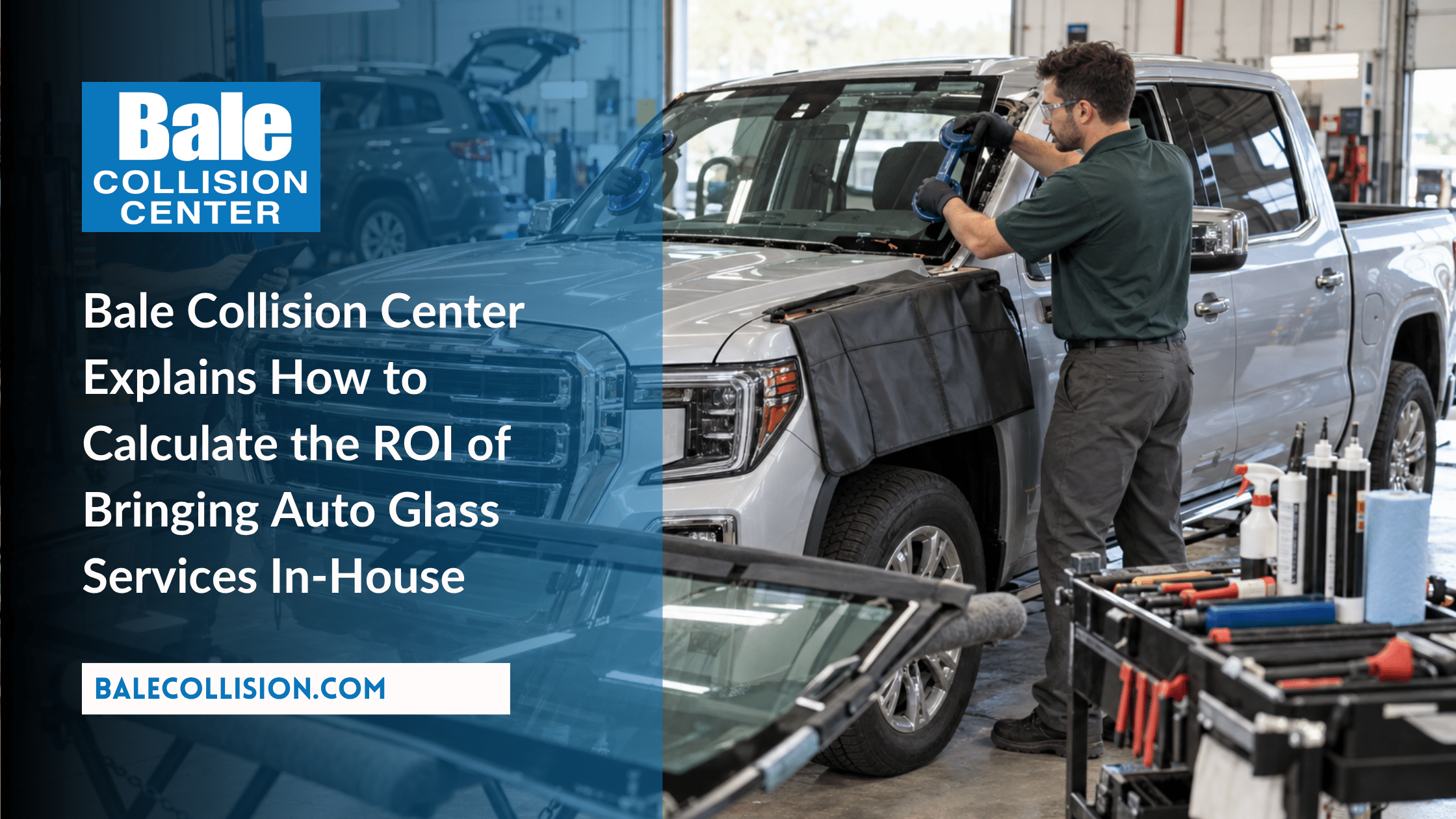
Bale Collision Center provides auto glass replacement services in Little Rock. The new guidance uses the company's service area as context for explaining the financial and operational considerations involved in evaluating an in-house glass program. It does not assume that bringing glass services in-house is the best financial decision for every repair business.
The first step is establishing the current cost of outsourcing. Repair facilities can review the number of glass jobs completed over a defined period, the amounts paid to outside providers, and any additional expenses associated with transportation, scheduling, or administrative coordination.
These figures provide a baseline for evaluating the existing arrangement. However, total outsourcing expenses should not automatically be treated as potential savings because an internal operation would introduce its own labor, materials, and overhead costs.
The second step is estimating the investment required to establish internal capabilities. Depending on the scope of services, expenses may include technician training, specialized tools, installation equipment, workspace preparation, inventory storage, insurance considerations, and required safety procedures.
Facilities should also account for ongoing operating costs. Replacement glass, adhesives, moldings, consumables, technician compensation, equipment maintenance, waste handling, and administrative work can affect the actual cost of each completed installation.
The November guidance recommends separating one-time startup expenses from recurring operating costs to avoid overstating the potential financial benefit.
Once these figures are established, repair businesses can estimate their contribution margin per glass job. This represents the revenue attributable to an internally completed service minus the variable costs directly associated with performing that work.
A basic calculation can be expressed as:
Annual incremental operating benefit = Annual in-house glass revenue minus annual in-house operating costs minus the contribution previously earned from outsourced glass work.
Annual ROI = (Annual incremental operating benefit minus annualized startup investment) divided by startup investment, multiplied by 100.
Because this simplified ROI calculation depends on how investment costs are allocated, businesses should use a consistent financial method and avoid counting the same startup expense twice.
A related calculation is the payback period, which estimates how long it may take for incremental cash benefits to recover the initial investment. Dividing the startup investment by the expected annual incremental cash benefit can provide a preliminary estimate when those benefits are positive and reasonably stable.
Service volume is another important consideration. A facility completing relatively few glass replacements may find that equipment, training, and staffing costs are difficult to recover. Higher volume can improve the opportunity to spread fixed expenses across more jobs, although actual profitability still depends on pricing and operating efficiency.
Bale Collision Center's guidance also addresses operational factors that may influence the financial calculation. Internal glass services can potentially reduce certain scheduling dependencies, but they also create responsibilities for parts ordering, inventory control, installation quality, and technician availability.
For collision repair facilities, these considerations should be evaluated alongside the broader collision repair process. Glass installation may need to be coordinated with body repairs, refinishing, adhesive curing requirements, and other vehicle-specific procedures.
Advanced Driver Assistance Systems add another cost consideration. Vehicles equipped with windshield-mounted cameras may require calibration after glass replacement according to manufacturer procedures. Businesses evaluating internal glass operations should determine whether they can perform the applicable calibration procedures or will continue using outside providers.
Bale Collision Center provides information about these requirements through its ADAS services. Calibration equipment, technician qualifications, workspace requirements, and outsourced calibration expenses may materially affect the economics of an internal glass program.
The November publication recommends testing multiple financial scenarios rather than relying on a single projected outcome. Repair businesses can compare conservative, expected, and higher-volume estimates to understand how changes in job count, labor expense, parts costs, and supplier pricing affect the potential return.
For Little Rock collision repair businesses, the central takeaway is that bringing auto glass services in-house should be evaluated as a measurable operational investment. A complete calculation considers both the potential financial benefits and the responsibilities that come with performing the work internally.
Bale Collision Center provides collision repair, auto body repair, glass replacement, and related vehicle services at its Chenal location, 13101 Chenal Pkwy, Little Rock, AR 72211.
###
For more information about Bale Collision Center, contact the company here:
Bale Collision Center (Chenal)
Jason Spiller
(501) 221-7181
jspiller@baleautomotive.com
13101 Chenal Pkwy, Little Rock, AR 72211, United States