Annals of Family Medicine: Researchers in China Examine Use of AI-Assisted Ultrasound by General Practitioners To Detect Carotid Artery Plaque
PR Newswire
PROVIDENCE, R.I., May 27, 2026
PROVIDENCE, R.I., May 27, 2026 /PRNewswire/ -- In a new feasibility study published in Annals of Family Medicine, general practitioners (GPs) in China were able to accurately detect carotid artery plaque — an indicator of cardiovascular disease — in high-risk patients using an AI-assisted portable ultrasound. However, diagnostic performance was not consistent across the participating GPs, and the authors caution that broader testing is needed before the approach can be widely adopted.
Carotid plaque is a buildup in the walls of the arteries of the neck that is associated with the onset of atherosclerotic cardiovascular disease. Point-of-care ultrasound, also known as POCUS, is a new tool being used in primary care. Recently, artificial intelligence (AI) features have been added to POCUS to improve image quality and diagnostic accuracy. This study examined whether an AI-assisted POCUS, paired with a training program, could help Chinese GPs use POCUS to screen for carotid artery plaque in their own community clinics.
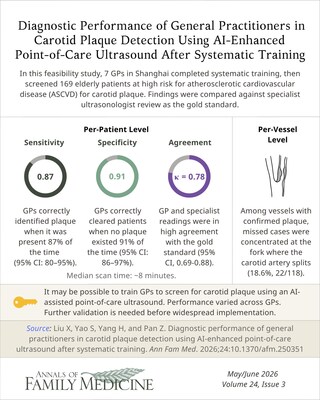
The study was conducted in Shanghai, China. Seven GPs completed a training program that combined classroom instruction with hands-on practice using an AI-assisted POCUS. They recruited 169 patients at high risk for atherosclerotic cardiovascular disease from four community health centers during regular outpatient visits, offering them free carotid plaque screening. Each patient was scanned by both a general practitioner and a senior ultrasound specialist. The device uses AI software to analyze the ultrasound image in real time and alert the operator with an on-screen marker when it detects potential plaque. Two senior ultrasound specialists independently reviewed all the stored recordings and images to determine who had carotid plaque. This served as the benchmark against which the GPs' findings were measured.
Looking at whether patients did or did not have plaque overall, the GPs correctly identified approximately 87% of patients who had plaque and correctly ruled it out in approximately 91% of patients who did not. Their findings showed a high level of agreement with the senior ultrasound specialist benchmark. Among vessels with confirmed plaque, missed cases were concentrated at the fork where the carotid artery splits (18.6%, 22/118). The authors suggest this could be due to the AI system's own limitations in that area or gaps in how GPs incorporated the AI's feedback into their workflow. Misidentifying plaque in patients who did not actually have it was less common.
Each scan took roughly 8 minutes to complete, which the researchers acknowledge could be difficult to fit into a typical GP appointment, where consultations times tend to be short. They suggest the approach might be better suited, at least initially, to more focused settings such as stroke screening clinics, community health outreach campaigns, or home-based care programs. The authors describe this as the first study of its kind to test structured POCUS training for GPs in China within a real clinical setting that included AI assistance.
"The widespread implementation of this AI-assisted POCUS approach will necessitate standardized, operator-specific training modules, as well as further validation in larger, more heterogeneous general practitioner cohorts, to ensure uniformly reliable performance," the authors write.
Article Cited:
Xiaochuan Liu, MD; Sichen Yao, BS; Hua Yang, Phd; and Zhigang Pan, Phd
Funding: This study was supported by the Shanghai Municipal Health Commission Key Supported Discipline Construction (General Practice 2023 ZDFC0401)
Annals of Family Medicine is an open access, peer-reviewed, indexed research journal that provides a cross-disciplinary forum for new, evidence-based information affecting the primary care disciplines. Launched in May 2003, Annals of Family Medicine is sponsored by six family medical organizations, including the American Academy of Family Physicians, the American Board of Family Medicine, the Society of Teachers of Family Medicine, the Association of Departments of Family Medicine, the Association of Family Medicine Residency Directors, and the North American Primary Care Research Group. Annals of Family Medicine is published online six times each year, charges no fee for publication, and contains original research from the clinical, biomedical, social, and health services areas, as well as contributions on methodology and theory, selected reviews, essays, and editorials. Complete editorial content and interactive discussion groups for each published article can be accessed for free on the journal's website, www.AnnFamMed.org.

 View original content to download multimedia:https://www.prnewswire.com/news-releases/annals-of-family-medicine-researchers-in-china-examine-use-of-ai-assisted-ultrasound-by-general-practitioners-to-detect-carotid-artery-plaque-302782478.html
SOURCE Annals of Family Medicine
